
Articles / Community / Security / Product / Visitor access
What Your Estate Car Sticker Should Show (and What It Shouldn’t)
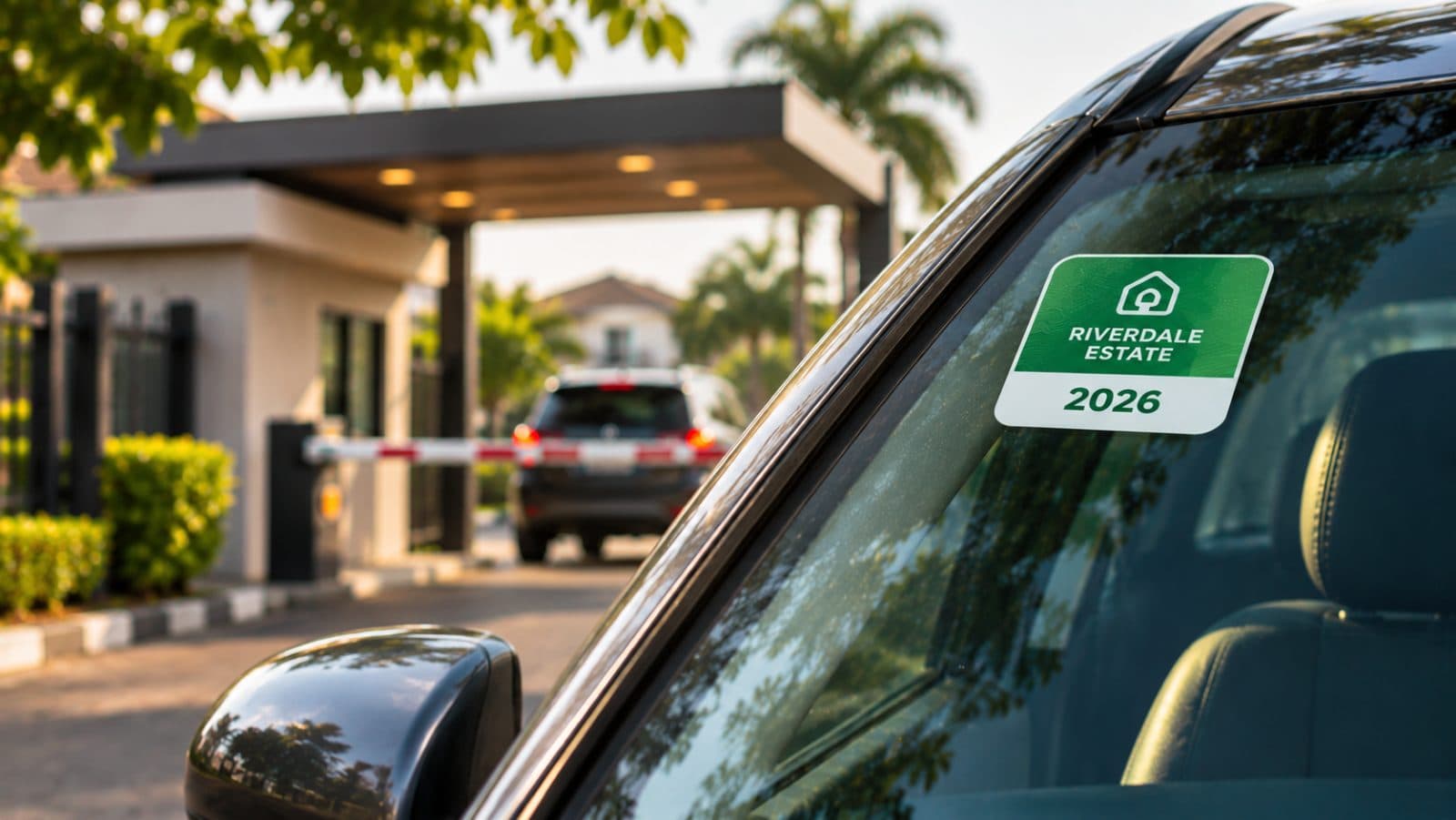
Most estate car stickers print the owner’s name, unit number or plate, and expect the guard to read them at a glance. That gives thieves the information they need to target a home. A sticker should do one job: help the guard say yes quickly and make the wrong car stand out.
During a visit to an estate in Lagos, we overheard one security officer tell another to let a man through. He was a resident, the officer said, but he had refused the estate’s sticker. We were curious, so we asked him why. He pointed to the risk. A sticker with his estate name or any trackable information on the windscreen tells anyone who sees it where he lives, and he was not willing to carry that around on his car.
He is not being difficult. He is right. And an estate whose residents quietly opt out of the sticker has a gate that no longer means anything.
The sticker is doing the wrong job
Most estate stickers print the estate name, address or car plate, and ask the guard to read them at a glance. That turns a security tool into a liability. A stranger in the car park now knows which house to watch. A thief who photographs the disc can reprint it. And a sticker peeled off one car and stuck on another still gets a wave at the gate, because nobody checks the plate behind it.
A sticker should do one job: help the guard decide quickly, and make the wrong car stand out. It should never tell anyone where a resident lives.
What the glass should carry
- A colour that changes each year, so last year’s disc stands out at the gate.
- A simple shape the guard already knows, for the two-second glance that keeps the morning queue moving.
- Nothing personal. No name, no unit, no phone number, no plate printed on the disc.
A plain disc still says “I paid, I belong” to the gate, and means nothing at a filling station or a car park outside. Keep the design simple and unofficial: no crests, seals or union-style symbols. The Lagos traffic authority, LASTMA, has warned that unauthorized stickers used as vehicle identifiers can get a car impounded (The Issues Magazine).
Colour gets the car moving. The check is what stops a thief.
A colour can be copied. Anyone who sees this year’s disc can match it. So the glance is only the first step, and how it is backed up depends on your gate.
- Manual gate. The guard reads the colour and shape to keep the line moving, and checks that at least one face in the car is familiar. If anything is in doubt, he looks the plate up, and that clears the decision. A cloned disc in the right colour still fails the moment the plate does not match a registered car.
- Boom barrier. The disc carries a code the barrier reads and checks against the estate’s live list. The code must be unique to that car, not a fixed value anyone can photograph and reuse.
Either way, the thing that actually stops a stolen or cloned car is not the print on the glass. It is a unique record in the system, and a gate that checks it.
This is where a printed sticker usually fails, and where Home Access closes the gap
An ordinary sticker, once printed, is loose forever. It cannot be switched off. If a car is stolen or the disc goes missing, the estate has nothing to cancel, because there was never anything unique tied to that car in the first place.
Home Access treats the disc the way it treats a visitor pass: tied to one car, and killable.
- The resident registers the car in the app — plate, make, colour. That record is the car’s identity, captured whether or not the levy is paid yet.
- The estate issues the sticker after payment, the same way it raises any other levy. Every disc gets a unique number for that car, for that year. The money stays with the estate.
- The guard still checks the plate at a manual gate, or the barrier checks the code. The colour moves the queue; the system makes the decision.
- A sticker can be killed the moment it needs to be. Car stolen: block it, and the guard turns it away. Disc lost or cracked: void the old number, issue a new one. Car sold: the old disc stops working, and the new owner registers afresh.
Because the identity is captured before anyone pays, an unpaid levy is handled as a bill to chase, not a resident locked out of their own home.
One rule holds the whole thing together: a working sticker is never emailed or sent as a file. A disc anyone can download is a disc anyone can reprint. Residents collect at the office, the way they already do.
What makes a disc harder to copy
- Destructible material, so it tears if peeled and cannot be reused.
- A fixed position on the windscreen, so every car looks the same to the guard and the odd one stands out.
- Tamper-evident print. It raises the effort, though no print is uncopyable, which is exactly why the unique record behind it matters.
What you can do this week
- Check your disc is for your current car and this year’s colour.
- If it is lost, stolen or damaged, tell your estate admin at once so it can be voided.
- Try to peel it. If it lifts off clean, ask for a destructible one.
The resident who refused his sticker was protecting himself. The right sticker protects him and the estate at the same time: it shows nothing about where he lives, and it is useless to anyone who copies it. That is the whole point of a sticker, and it is what Home Access is built to do, from the resident registering the car to the guard at the gate to the one tap that kills a stolen disc.
If your estate still runs on stickers anyone can reprint, talk to your estate admin about Home Access.

Laura
Home Access Technology Ltd · 2 November 2026