
Articles / Community / Visitor access / Product
What Happens at Your Estate Gate When the Network Goes Down
The part that should worry the committee is that nobody, anywhere, wrote that man's name down. This is about what happens to your estate's visitor record on the nights your access system cannot reach the internet, and what a committee should ask before choosing one.
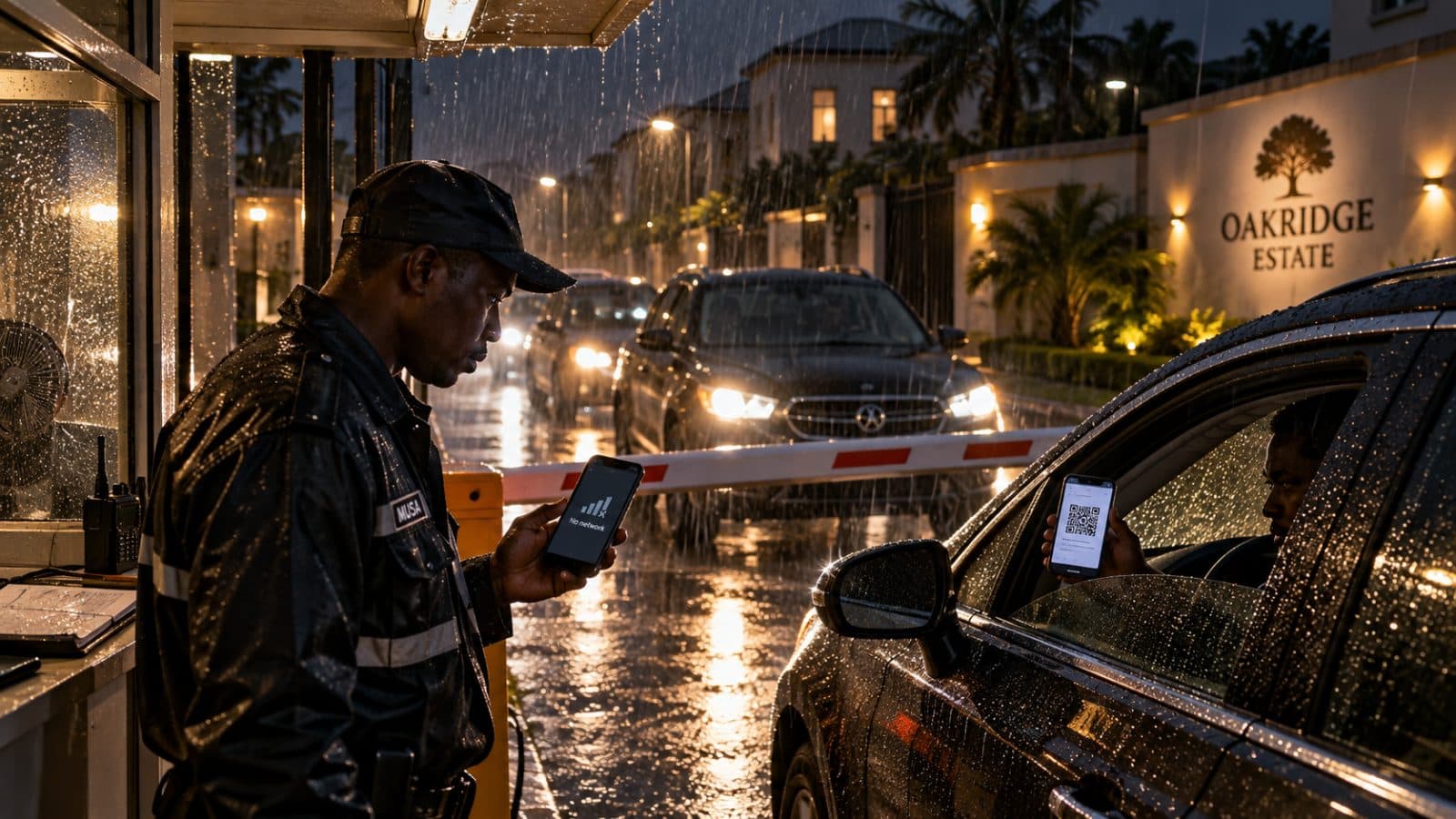
Musa has worked the gate of an estate in Lagos for two years. He is the one you see if you come in after dark, and he is the reason the barrier goes up. He told me about a Thursday in July, and he told it as a small thing, the way you mention something that happens often enough not to be a story.
It had been raining since five. He was under the overhang, which keeps the rain off your head and not much else, and there was a car at the barrier with its window down about four inches.
The driver said he had a code.
He held his phone up against the glass so Musa could see it. A code on a screen, the kind residents send their guests all day. Musa took out his own phone to check it, and nothing happened. The screen just sat there. No network.
So he did the next best thing. He called the resident.
The first call did not connect. The second rang twice and cut. He tried a third time, saying hello into a phone that had one bar and was not really there, while rain came in through the gap in the driver's window and the driver said nothing, because what is there to say.
Behind that car, another car arrived. Then a third. Somebody touched their horn, once, not rudely.
Musa let the man in.
He had a code, and the estate had no way to check it, and there were three cars waiting in the rain. Musa says he was probably right. He is probably right. That is not the part that should worry the committee.
The part that should worry the committee is that nobody, anywhere, wrote that man's name down.
The record stops before the gate does
When the gate system goes down, most estates fall back to whatever worked before. A notebook. A phone call. A guard who recognises the face and waves the car through. Each of those is a decision made with no record.
The man who came in at 8:40pm that Thursday exists nowhere. Not in the app, because the app could not reach anything. Not in a notebook, because Musa's hands were wet and there were three cars waiting and the notebook lives inside the gatehouse. Not in anyone's memory beyond that night, because by Saturday it was one of forty cars.
Most nights, this costs nothing.
But the night it costs something is exactly the night nothing was written. Something goes missing. A neighbour reports a car that had no business being inside. The committee meets and someone asks the only question that matters. Who came in, and when.
And the answer is that nobody knows, because it was raining.
He had a code. That should have been the end of it
The system had already worked. A resident approved a visitor. A code was issued. The visitor arrived with it and offered it before he was asked. Everyone did exactly what the estate wanted them to do.
Everything worked except the last three seconds.
Musa could not check the code, because checking it meant reaching a server, and reaching a server meant having a network, and the network was gone. A system that had correctly recorded an approved visitor could not tell the man at the gate that the visitor was approved.
So he guessed. He guessed right. But a guess goes both ways, and the next one might go the other direction. He might turn away somebody's mother.
Why it is always raining in this story
Network failure is not random with respect to risk. Heavy rain disrupts mobile service, and MTN's own executives have said so publicly.
Heavy rain also means darker streets, fewer people walking, guards standing under an overhang rather than out at the barrier, and residents indoors with their phones face down on the table, which is why the calls are not answered.
The conditions that break your gate system are the same conditions that make your estate easier to walk into. So the holes in your record are not spread evenly across the year. They cluster on precisely the nights you would most want to look back at.
This belongs to the committee, not the guard
Ask a guard what he does when the app will not load and he will tell you, if you ask kindly. He calls the resident. If nobody answers, he decides, and that decision rests on familiarity. The man looks like he has been here before. The car has passed through plenty of times.
But a face a guard knows might belong to a former tenant, or a contractor whose job ended last month. None of that is carelessness. Musa was given a job and then given no way to do it.
Estates try to close the gap with physical credentials. Vehicle stickers work at a distance in bad weather, but a sticker only says the car is known. It does not say the car is welcome tonight.
The gate record belongs to the association in the same way the accounts do. When one committee hands over to the next, it hands over what it can show. Holes in the visitor log on the worst nights of the year are a governance failure that happens to occur at a gate.
It matters for another reason. The gate is increasingly where estates try to enforce everything else, dues included. The courts have held that payment of estate dues is voluntary and cannot be compelled, and denying a resident entry to their own home raises constitutional questions. There are lawful ways to handle a defaulting resident, and the barrier is not one of them. None of that reasoning survives if the gate does not know who anybody is.
Three questions worth asking before you sign anything
Committees evaluating access control usually ask how many visitor types a system supports and whether it does QR codes. Reasonable questions, and not the hard ones.
The first hard one is what happens when the guard's phone has no internet. If entry stops, or the guard goes back to a notebook, you are buying a system that works on good nights and disappears on bad ones.
The second is whether a visitor approved five minutes ago can be verified by a guard who has had no signal for an hour. Most systems cannot do it.
The third is whether entries made offline still reach the estate's log once the connection returns. A system that lets people in during an outage but does not record them has solved the queue and left the real problem where it was.
Home Access answers yes to all three, which is why we built it that way. Ask us the questions anyway, and ask whoever else you are speaking to.
Back at the gate
Musa is still on that gate. Most nights the network is fine and the barrier goes up before the driver has finished winding down his window.
But it rains a lot in Lagos between May and October, and the estate has a record with holes in it that nobody has noticed, because you only notice a missing record on the one night you go looking.
A good gate system is not the one with the most features on a slide. It is the one that behaves the same at 8:40pm on a wet Thursday as it does at 11am on a clear Tuesday when the vendor is in the room demonstrating it. That is a reasonable thing for a committee to insist on, and it costs nothing to ask before you sign.
Home Access keeps verifying visitors at the gate when the network drops, and every entry still reaches your estate log once the connection returns. See how it works at homeaccess.africa.

Sam
Home Access Technology Ltd · 23 September 2026