
Articles / Product / Community
Running an Estate Where Half the Plots Are Still Undeveloped
Developing estates on the Lagos-Ibadan corridor and beyond face a problem mature estates do not: too few residents funding shared infrastructure. Practical approaches to dues, security and governance at low occupancy.
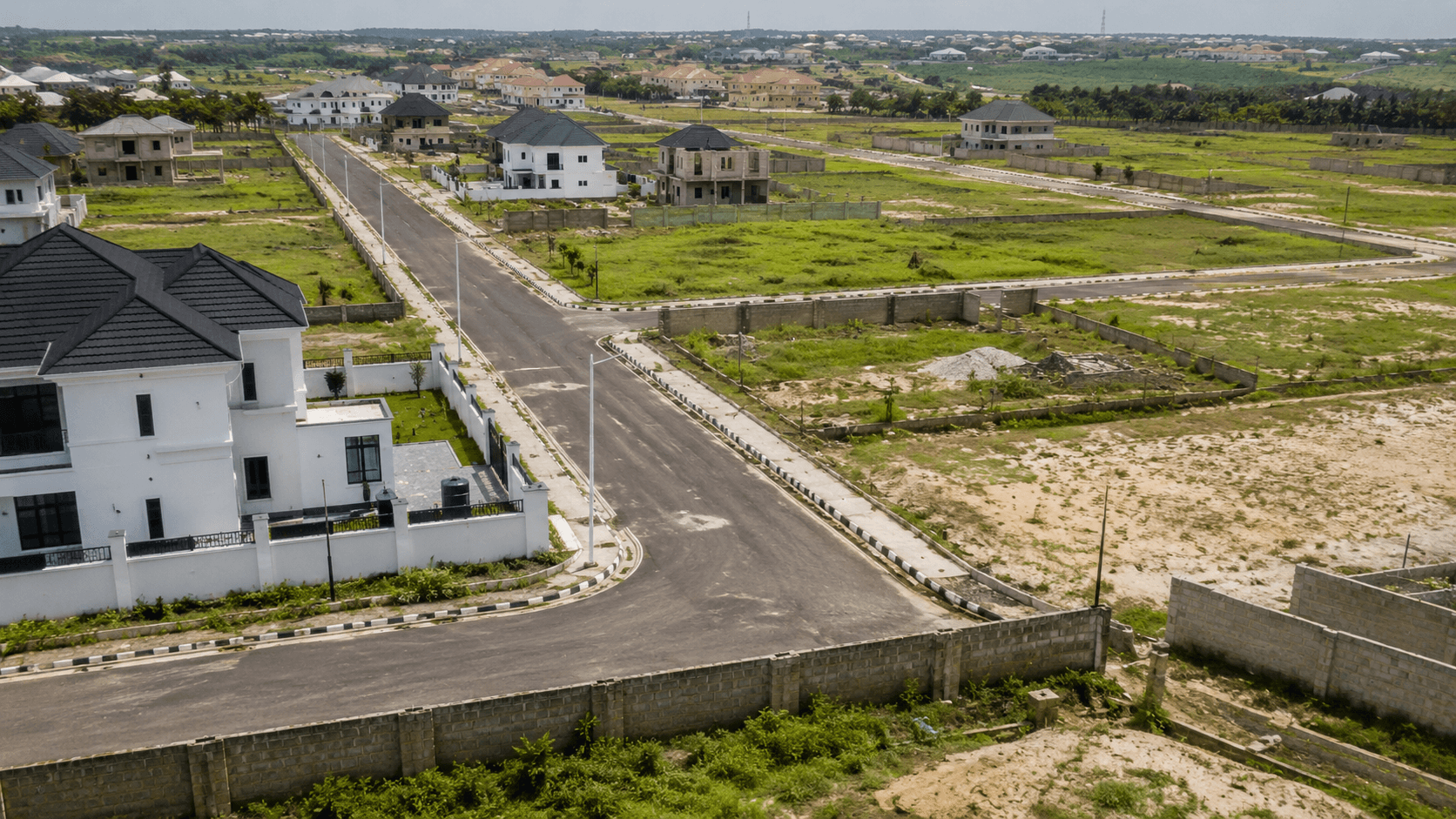
Most advice written for Nigerian estate committees assumes a finished estate. Every plot built, every unit occupied, a full complement of residents sharing the cost of security, drainage and streetlights.
A great many estates are nothing like that. On the Lagos–Ibadan corridor, around Magboro, Mowe, Simawa and Ibafo, and across the growth belts of Abuja, Ibadan and Port Harcourt, there are estates with allocated plots, laid roads, a functioning gate and forty families living inside a perimeter designed for two hundred.
These estates have a distinct set of problems, and applying mature-estate playbooks to them produces bad outcomes. This article is about what actually works at low occupancy.
The core problem: fixed costs, variable contributors
A gate needs the same number of guards whether the estate holds 40 households or 200. The perimeter needs the same patrolling. The access road needs the same grading after the rains. The transformer needs the same maintenance.
Nearly all of an estate's essential costs are fixed against the size of the estate, not the number of people living in it. But contributions scale with occupancy. At 20% occupancy, a fifth of the households are funding the whole thing.
That arithmetic produces the pattern every developing estate recognises: the early residents pay far more per household than residents of a comparable finished estate, feel it acutely, and start asking why. Some stop paying. Security is cut back. The estate becomes less attractive, occupancy grows more slowly, and the burden on the remaining payers gets worse.
Breaking that cycle is the central governance task of a developing estate.
Who pays for an empty plot?
This is the question that decides everything else, and there is no universally right answer — only a decision your estate needs to make explicitly rather than by default.
Option one: only occupied units pay. The simplest and most common default. It is also the one that puts the entire burden on early residents and creates the death spiral described above. It rewards plot owners who bought as an investment and are waiting for land values to rise while contributing nothing to the infrastructure that raises them.
Option two: all allocated plots pay, at a reduced rate. Occupied units pay full service charge; undeveloped plots pay a lower holding or infrastructure levy. The reasoning is straightforward and defensible at an AGM: an unbuilt plot still benefits from the perimeter, the gate, the roads and the estate's reputation, all of which support the value of the land. The plot owner is buying appreciation that the residents are funding.
This spreads the load considerably. It is also harder to collect, because an absentee plot owner has less immediate incentive to pay than someone living behind the gate — and less to lose from the usual enforcement levers.
Option three: the developer subsidises until a threshold. Where a developer is still selling plots in the estate, they have a direct commercial interest in the estate looking well run. Some estates negotiate for the developer to cover a share of security and maintenance until occupancy reaches an agreed level. This is worth pursuing early, while the developer still has unsold inventory and therefore still needs you.
Option four: differential rates by development stage. Occupied, built-but-vacant, under-construction, and undeveloped, each at a different rate. More precise, more administrative work, and it requires you to actually know the status of every plot — which most developing estates do not.
Whichever you choose, write it into the constitution or estate rules and get it adopted properly at a general meeting. A levy on undeveloped plots invented by a committee and applied without a documented basis is exactly the kind of thing an absentee plot owner refuses to pay and then challenges.
Getting the arithmetic in front of residents
Developing estates have more dues disputes per household than mature ones, for a straightforward reason: the amounts feel disproportionate to what residents see. Someone paying substantial monthly dues while looking out at bush and unbuilt plots wants to know what exactly they are funding.
The answer to that is arithmetic, published.
Show the annual cost of security, the annual cost of road and drainage maintenance, the transformer and streetlight costs, and the administrative costs. Show how many households are contributing. Show the resulting per-household figure. Then show what that figure becomes at 50% occupancy, and at full occupancy.
That last part is the one that changes the conversation. It reframes the current dues from an imposition into a phase — and it gives every resident a direct financial interest in the estate filling up, which turns them into advocates for occupancy rather than complainants about cost.
Security at low occupancy
Developing estates carry a security profile that finished estates do not, and it is worth naming plainly.
Long stretches of unwatched perimeter. Undeveloped sections mean no residents overlooking them, no lighting, and easy approach. Perimeter is a bigger share of your risk than gate control.
Construction traffic. An estate that is still building has a constant flow of workers, materials trucks, and site vehicles that do not belong to residents and cannot be recognised on sight. This is the single largest gap in most developing estates' access control — and it is also the route by which building materials leave the estate.
Occupied units surrounded by empty ones. A household with no neighbours has no informal surveillance, which is the thing that actually deters opportunistic crime in dense estates.
Fewer people, less funding, same perimeter. You need more security than a mature estate of the same footprint, and you can afford less.
Practical responses that do not require a large budget: log every construction worker and material movement, with a named resident or contractor accountable for each; require material exit confirmation from the plot owner before anything leaves; keep a searchable record of who came in and when, because the value of a gate log is entirely in being able to search it after an incident; and concentrate lighting on the undeveloped stretches rather than the populated ones, which is counterintuitive but correct.
---
Governance while the estate is still small
A forty-household estate can be run informally, and usually is. That works until it does not — typically at the point where the estate has grown enough that the original committee no longer knows everyone personally, which arrives faster than anyone expects.
The things worth establishing early, because they are much harder to retrofit:
A proper resident register. Every unit, every household, every contact. Build it while there are forty units, not four hundred.
Documented rule acknowledgement. Every incoming resident acknowledges the estate rules on arrival. Capturing consent at move-in is trivially easy. Reconstructing it three years later for a resident in dispute is impossible.
A real constitution, properly adopted. Small estates run on consensus and then discover, during the first serious disagreement, that nothing was ever written down.
Accounts that survive a committee handover. Volunteer committees rotate. If the dues history lives in one person's spreadsheet and one person's memory, the next committee starts from nothing and every historical arrear becomes unrecoverable.
A plot register that tracks development status. You cannot operate differential rates, or plan security, without knowing what is built, what is under construction, and what is bush.
The one thing that changes the trajectory
Developing estates that end up well run are almost always the ones that got the funding model right early — where the burden was spread across all allocated plots rather than dumped on the first forty families, and where residents could see the arithmetic.
Estates that get it wrong follow a recognisable path: early residents overpay, resentment builds, collection falls, security thins, the estate develops a reputation, occupancy stalls, and the residents who stayed carry an even heavier load.
The decision that separates the two outcomes is usually taken in the estate's first two or three years, by a small committee that did not realise it was making a decision that mattered.
Written by Home Access — a Nigerian estate management platform used by residents' associations, including estates that are still filling up. homeaccess.africa
This article is general information, not legal advice. Levies on undeveloped plots should be reviewed by a qualified Nigerian property lawyer and properly adopted before your estate applies them.

Laura
Home Access Technology Ltd · 17 August 2026